The Man Charged With Exposing the Baby Oedipus Died in the Conflict in Which Laius Was Killed
| Oedipus Rex | |
|---|---|
 Louis Bouwmeester equally Oedipus in a Dutch production of Oedipus Rex, c. 1896 | |
| Written by | Sophocles |
| Chorus | Theban Elders |
| Characters |
|
| Mute | Daughters of Oedipus (Antigone and Ismene) |
| Date premiered | c. 429 BC |
| Place premiered | Theatre of Dionysus, Athens |
| Original language | Classical Greek |
| Series | Theban Plays |
| Genre | Tragedy |
| Setting | Thebes |
Oedipus Rex , also known by its Greek title, Oedipus Tyrannus (Ancient Greek: Οἰδίπους Τύραννος, pronounced [oidípoːs týrannos]), or Oedipus the King , is an Athenian tragedy past Sophocles that was outset performed around 429 BC.[1] Originally, to the aboriginal Greeks, the championship was simply Oedipus ( Οἰδίπους ), as it is referred to past Aristotle in the Poetics. It is thought to have been renamed Oedipus Tyrannus to distinguish it from Oedipus at Colonus, a later play past Sophocles. In antiquity, the term "tyrant" referred to a ruler with no legitimate merits to dominion, but it did not necessarily have a negative connotation.[ii] [3] [4]
Of Sophocles' three Theban plays that accept survived, and that deal with the story of Oedipus, Oedipus King was the second to be written, following Antigone by about a dozen years. However, in terms of the chronology of events described past the plays, information technology comes first, followed by Oedipus at Colonus and and so Antigone.
Prior to the offset of Oedipus Rex, Oedipus has become the male monarch of Thebes while unwittingly fulfilling a prophecy that he would kill his father, Laius (the previous rex), and marry his mother, Jocasta (whom Oedipus took equally his queen after solving the riddle of the Sphinx). The activity of Sophocles's play concerns Oedipus's search for the murderer of Laius in order to terminate a plague ravaging Thebes, unaware that the killer he is looking for is none other than himself. At the end of the play, after the truth finally comes to light, Jocasta hangs herself while Oedipus, horrified at his patricide and incest, gain to gouge out his ain eyes in despair.
In his Poetics, Aristotle refers several times to the play in society to exemplify aspects of the genre.[5] [6]
Context [edit]
Curse upon Laius [edit]
The misfortunes of Thebes are believed to be the result of a curse laid upon Laius for the time he had violated the sacred laws of hospitality (Greek: xenia).
In his youth, Laius was taken in as a guest by Pelops, king of Elis, where he would go tutor to the king's youngest son, Chrysippus, in chariot racing.
Nascency of Oedipus [edit]
When Laius' son is built-in, he consults an oracle as to his fortune. To his horror, the oracle reveals that Laius "is doomed to perish by the hand of his own son." Laius binds the infant's anxiety together with a pin and orders Jocasta to kill him. Unable to exercise so to her own son, Jocasta orders a servant to slay the babe instead. The servant exposes the infant on a mountaintop, where he is found and rescued past a shepherd. (In other versions, the servant gives the infant to the shepherd.)
The shepherd names the child Oedipus, "swollen foot", every bit his feet had been tightly spring by Laius. The shepherd brings the infant to Corinth, and presents him to the childless king Polybus, who raises Oedipus as his own son.
Oedipus and the Oracle [edit]
As he grows to manhood, Oedipus hears a rumour that he is non truly the son of Polybus and his wife, Merope. He asks the Delphic Oracle who his parents really are. The Oracle seems to ignore this question, telling him instead that he is destined to "mate with [his] own mother, and shed/With [his] ain hands the blood of [his] own sire." Drastic to avoid this terrible fate, Oedipus, who still believes that Polybus and Merope are his true parents, leaves Corinth for the city of Thebes.

Fulfilling prophecy [edit]
The old man [edit]
On the road to Thebes, Oedipus encounters an old man and his servants. The two begin to quarrel over whose chariot has the right of way. While the erstwhile human being moves to strike the insolent youth with his scepter, Oedipus throws the man down from his chariot, killing him. Thus, the prophecy in which Oedipus slays his ain begetter is fulfilled, as the old human—equally Oedipus discovers later—was Laius, rex of Thebes and true father to Oedipus.
Riddle of the Sphinx [edit]
Arriving at Thebes, a city in turmoil, Oedipus encounters the Sphinx, a legendary fauna with the caput and breast of a woman, the body of a lioness, and the wings of an eagle. The Sphinx, perched on a colina, was devouring Thebans and travellers one by i if they could not solve her riddle.
The precise riddle asked past the Sphinx varied in early traditions, and is not explicitly stated in Oedipus Rex, as the upshot precedes the play. Even so, according to the nearly widely regarded version of the riddle, the Sphinx asks "what is the animal that walks on four legs in the morning, two legs at noon, and three in the evening?" Oedipus, blest with great intelligence, answers correctly: "human being" (Greek: anthrôpos), who crawls on all fours as an baby; walks upright in maturity; and leans on a stick in sometime age.[viii] : 463
Bested past the prince, the Sphinx throws herself from a cliff, thereby catastrophe the curse.[9] Oedipus' reward for freeing Thebes from the Sphinx is kingship to the city and the hand of its dowager queen, Jocasta. None, at that point, realize that Jocasta is Oedipus' true mother.[ten] Thus, unbeknownst to either character, the remaining prophecy has been fulfilled.
Plot [edit]

P. Oxy. 1369, a bitty papyrus copy of Oedipus Rex, 4th century BC.
Oedipus, King of Thebes, sends his brother-in-law, Creon, to inquire the advice of the oracle at Delphi, concerning a plague ravaging Thebes. Creon returns to report that the plague is the result of religious pollution, since the murderer of their former king, Laius, has never been caught. Oedipus vows to find the murderer and curses him for causing the plague.
Oedipus summons the blind prophet Tiresias for help. Tiresias admits to knowing the answers to Oedipus' questions, simply he refuses to speak, instead telling Oedipus to carelessness his search. Angered by the seer's answer, Oedipus accuses him of complicity in Laius' murder. The offended Tiresias then reveals to the rex that "[y]ou yourself are the criminal you lot seek". Oedipus does not understand how this could be, and supposes that Creon must have paid Tiresias to accuse him. The two fence vehemently, as Oedipus mocks Tiresias' lack of sight, and Tiresias retorts that Oedipus himself is bullheaded. Eventually, the prophet leaves, muttering darkly that when the murderer is discovered, he shall be a native of Thebes, blood brother and father to his own children, and son and husband to his own mother.
Creon arrives to face Oedipus'southward accusations. The King demands that Creon be executed; even so, the chorus persuades him to let Creon alive. Jocasta, wife of first Laius and so Oedipus, enters and attempts to condolement Oedipus, telling him he should take no notice of prophets. As proof, she recounts an incident in which she and Laius received an oracle which never came true. The prophecy stated that Laius would be killed past his ain son; instead, Laius was killed past bandits, at a fork in the road (τριπλαῖς ἁμαξιτοῖς, triplais amaxitois).
The mention of the place causes Oedipus to pause and inquire for more details. Jocasta specifies the branch to Daulis on the way to Delphi. Recalling Tiresias' words, he asks Jocasta to draw Laius. The male monarch then sends for a shepherd, the but surviving witness of the attack to exist brought from his fields to the palace.
Confused, Jocasta asks Oedipus what the matter is, and he tells her. Many years ago, at a feast in Corinth, a man drunkenly accused Oedipus of not being his male parent's son. Oedipus went to Delphi and asked the oracle about his parentage. Instead of answering his question direct, the oracle prophesied that he would one day murder his begetter and sleep with his mother. Upon hearing this, Oedipus resolved never to render to Corinth. In his travels, he came to the very crossroads where Laius had been killed, and encountered a wagon that attempted to drive him off the route. An argument ensued, and Oedipus killed the travelers—including a man who matched Jocasta'south description of Laius. However, Oedipus holds out hope that he was not Laius' killer, because Laius was said to take been murdered by several robbers. If the shepherd confirms that Laius was attacked by many men, then Oedipus will exist in the clear.
A man arrives from Corinth with the bulletin that Polybus, who raised Oedipus as his son, has died. To the surprise of the messenger, Oedipus is overjoyed, because he can no longer impale his father, thus disproving one-half of the oracle's prophecy. However, he yet fears that he might somehow commit incest with his mother. Eager to prepare the king'due south mind at ease, the messenger tells him non to worry, because Merope is not his existent mother.
The messenger explains that years earlier, while tending his flock on Mount Cithaeron, a shepherd from the household of Laius brought him an infant that he was instructed to dispose of. The messenger had then given the child to Polybus, who raised him. Oedipus asks the chorus if anyone knows the identity of the other shepherd, or where he might be now. They respond that he is the same shepherd who witnessed the murder of Laius, and whom Oedipus had already sent for. Jocasta, realizing the truth, badly begs Oedipus to stop asking questions. When Oedipus refuses, the queen runs into the palace.
When the shepherd arrives Oedipus questions him, but he begs to be immune to get out without answering farther. Notwithstanding, Oedipus presses him, finally threatening him with torture or execution. It emerges that the child he gave away was Laius' own son. In fear of a prophecy that the child would impale his father, Jocasta gave her son to the shepherd in lodge to exist exposed upon the mountainside.
Everything is at terminal revealed, and Oedipus curses himself and fate earlier leaving the stage. The chorus laments how even a great homo can be felled past fate, and following this, a servant exits the palace to speak of what has happened within. Jocasta has hanged herself in her sleeping accommodation. Entering the palace in anguish, Oedipus chosen on his servants to bring him a sword, that he might slay Jocasta with his ain mitt. But upon discovering the lifeless queen, Oedipus took her downwardly, and removing the long aureate pins from her dress, he has gouged out his own eyes in despair.
The blinded male monarch now exits the palace, and begs to be exiled. Creon enters, maxim that Oedipus shall be taken into the house until oracles can be consulted regarding what is all-time to be done. Oedipus's 2 daughters (and one-half-sisters), Antigone and Ismene, are sent out and Oedipus laments their having been born to such a cursed family. He begs Creon to watch over them, in hopes that they will alive where at that place is opportunity for them, and to have a improve life than their begetter. Creon agrees, before sending Oedipus back into the palace.
On an empty stage, the chorus repeats the mutual Greek maxim that "no man should be considered fortunate until he is expressionless."[11]
Relationship with mythic tradition [edit]
The two cities of Troy and Thebes were the major focus of Greek epic poesy. The events surrounding the Trojan War were chronicled in the Ballsy Cycle, of which much remains, and those almost Thebes in the Theban Bicycle, which have been lost. The Theban Bike recounted the sequence of tragedies that befell the house of Laius, of which the story of Oedipus is a function.
Homer'southward Odyssey (Xi.271ff.) contains the primeval account of the Oedipus myth when Odysseus encounters Jocasta (named Epicaste) in the underworld. Homer briefly summarises the story of Oedipus, including the incest, patricide, and Jocasta's subsequent suicide. Nevertheless, in the Homeric version, Oedipus remains King of Thebes after the revelation and neither blinds himself, nor is sent into exile. In detail, it is said that the gods made the thing of his paternity known, whilst in Oedipus the King, Oedipus very much discovers the truth himself.[12]
In 467 BC, Sophocles'south fellow tragedian Aeschylus won kickoff prize at the City Dionysia with a trilogy most the House of Laius, comprising Laius, Oedipus and Seven Against Thebes (the only play which survives). Since he did not write connected trilogies every bit Aeschylus did, Oedipus Rex focuses on the titular character while hinting at the larger myth obliquely, which was already known to the audience in Athens at the time.
Reception [edit]

Bénigne Gagneraux, The Bullheaded Oedipus Commending his Children to the Gods
The trilogy containing Oedipus Rex took second prize in the City Dionysia at its original performance. Aeschylus'south nephew Philocles took kickoff prize at that competition.[xiii] However, in his Poetics, Aristotle considered Oedipus King to be the tragedy which best matched his prescription for how drama should be made.[fourteen]
Many modern critics hold with Aristotle on the quality of Oedipus King, fifty-fifty if they don't ever agree on the reasons. For example, Richard Claverhouse Jebb claimed that "The Oedipus Tyrannus is in 1 sense the masterpiece of Cranium tragedy. No other shows an equal degree of fine art in the development of the plot; and this excellence depends on the powerful and subtle drawing of the characters."[fifteen] Cedric Whitman noted that "the Oedipus Male monarch passes nearly universally for the greatest extant Greek play..."[16] Whitman himself regarded the play every bit "the fullest expression of this conception of tragedy," that is the conception of tragedy as a "revelation of the evil lot of man," where a man may have "all the equipment for glory and honor" but still accept "the greatest effort to do adept" end in "the evil of an unbearable self for which ane is not responsible.[17] Edith Hall referred to Oedipus the King every bit "this definitive tragedy" and notes that "the magisterial subtlety of Sophocles' label thus lend credibility to the breathtaking coincidences," and notes the irony that "Oedipus can only fulfill his exceptional god-ordained destiny because Oedipus is a preeminently capable and intelligent man."[18] H. D. F. Kitto said well-nigh Oedipus Rex that "it is true to say that the perfection of its form implies a world order," although Kitto notes that whether or not that world lodge "is beneficent, Sophocles does not say."[19]
The scientific discipline revolution attributed to Thales began gaining political force, and this play offered a warning to the new thinkers. Kitto interprets the play equally Sophocles' antiphon to the sophists, by dramatizing a situation in which humans face undeserved suffering through no fault of their own, only despite the apparent randomness of the events, the fact that they have been prophesied by the gods implies that the events are non random, despite the reasons being across man comprehension.[twenty] Through the play, co-ordinate to Kitto, Sophocles declares "that it is wrong, in the face of the incomprehensible and unmoral, to deny the moral laws and have chaos. What is correct is to recognize facts and not delude ourselves. The universe is a unity; if, sometimes, we can encounter neither rhyme nor reason in it nosotros should not suppose it is random. There is and so much that we cannot know and cannot control that we should not call up and comport as if we do know and can control.[20]
Oedipus Rex is widely regarded as one of the greatest plays, stories, and tragedies ever written.[21] [22] In 2015, when Guardian's theatre critic Michael Billington, selected what he thinks are the 101 greatest plays ever written, Oedipus Rex was placed second, just afterwards The Persians.[23]
Themes, irony and motifs [edit]
Fate, complimentary will, or tragic flaw [edit]

A Greek amphora depicting Oedipus and the Sphinx, circa 450 BC.
Fate is a motif that often occurs in Greek writing, tragedies in particular. Likewise, where the attempt to avoid an oracle is the very thing that enables it to happen is common to many Greek myths. For example, similarities to Oedipus can be seen in the myth of Perseus' birth.
Two oracles in particular dominate the plot of Oedipus Male monarch. Jocasta relates the prophecy that was told to Laius before the nascency of Oedipus (lines 711–iv):
[The oracle] told him
that it was his fate that he should die a victim
at the hands of his own son, a son to exist born
of Laius and me.
The oracle told to Laius tells only of the patricide, whereas the incest is missing. Prompted by Jocasta'southward recollection, Oedipus reveals the prophecy which caused him to get out Corinth (lines 791–three):
that I was blighted to lie with my mother,
and show to daylight an accursed breed
which men would not endure, and I was doomed
to be murderer of the male parent that begot me.
The implication of Laius'due south oracle is ambiguous. 1 interpretation considers that the presentation of Laius's oracle in this play differs from that found in Aeschylus's Oedipus trilogy produced in 467 BC. Smith (2005) argues that "Sophocles had the option of making the oracle to Laius conditional (if Laius has a son, that son volition kill him) or unconditional (Laius will accept a son who will kill him). Both Aeschylus and Euripides write plays in which the oracle is provisional; Sophocles...chooses to make Laius's oracle unconditional and thus removes culpability for his sins from Oedipus, for he could non have done other than what he did, no matter what action he took."[24] [25]
This interpretation is supported by Jocasta's repetition of the oracle at lines 854–55: "Loxias declared that the male monarch should be killed past/ his ain son." In Greek, Jocasta uses the verb chrênai: "to be blighted, necessary." This iteration of the oracle seems to advise that it was unconditional and inevitable.
Other scholars take nevertheless argued that Sophocles follows tradition in making Laius's oracle conditional, and thus avoidable. They point to Jocasta'south initial disclosure of the oracle at lines 711–fourteen. In Greek, the oracle cautions: " hôs auton hexoi moira pros paidos thanein/ hostis genoit emou te kakeinou para. " The two verbs in boldface betoken what is called a "future more vivid" status: if a child is built-in to Laius, his fate to exist killed by that child will overtake him.[26]
Whatever the pregnant of Laius's oracle, the one delivered to Oedipus is clearly unconditional. Given the modern conception of fate and fatalism, readers of the play have a trend to view Oedipus as a mere puppet controlled by greater forces; a human being crushed by the gods and fate for no good reason. This, even so, is not an entirely accurate reading. While it is a mythological truism that oracles exist to be fulfilled, oracles do not crusade the events that lead up to the outcome. In his landmark essay "On Misunderstanding the Oedipus Rex",[27] East.R. Dodds draws upon Bernard Knox'south comparison with Jesus' prophecy at the Last Supper that Peter would deny him three times. Jesus knows that Peter will do this, just readers would in no way advise that Peter was a puppet of fate being forced to deny Christ. Free volition and predestination are past no means mutually exclusive, and such is the case with Oedipus.
The oracle delivered to Oedipus is what is frequently chosen a "self-fulfilling prophecy," whereby a prophecy itself sets in movement events that conclude with its own fulfilment.[28] This, however, is not to say that Oedipus is a victim of fate and has no gratuitous will. The oracle inspires a series of specific choices, freely made past Oedipus, which lead him to kill his begetter and marry his mother. Oedipus chooses not to render to Corinth later on hearing the oracle, but as he chooses to head toward Thebes, to kill Laius, and to take Jocasta specifically every bit his wife. In response to the plague at Thebes, he chooses to transport Creon to the Oracle for communication and then to follow that advice, initiating the investigation into Laius' murder. None of these choices are predetermined.
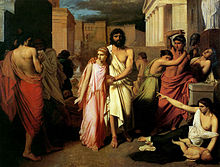
Some other feature of oracles in myth is that they are almost always misunderstood by those who hear them; hence Oedipus misunderstanding the significance of the Delphic Oracle. He visits Delphi to observe out who his real parents are and assumes that the Oracle refuses to reply that question, offering instead an unrelated prophecy which forecasts patricide and incest. Oedipus' supposition is incorrect, the Oracle does, in a manner, answer his question. On closer analysis the oracle contains essential data which Oedipus seems to neglect. The wording of the Oracle: "I was doomed to be murderer of the father that begot me" refers to Oedipus' existent, biological father. Likewise the mother with polluted children is defined as the biological ane. The wording of the drunken guest on the other hand: "you are not your father's son" defines Polybus as but a foster male parent to Oedipus. The two wordings support each other and bespeak to the "two set of parents" culling. Thus the question of two set of parents, biological and foster, is raised. Oedipus' reaction to the Oracle is irrational: he states he did not go any answer and he flees in a direction away from Corinth, showing that he firmly believed at the time that Polybus and Merope are his real parents.
The scene with the drunken guest constitutes the finish of Oedipus' childhood. He can no longer ignore a feeling of dubiousness about his parentage. However, after consulting the Oracle this doubt disappears, strangely enough, and is replaced past a totally unjustified certainty that he is the son of Merope and Polybus. We take said that this irrational behaviour—his hamartia, as Aristotle puts it—is due to the repression of a whole series of thoughts in his consciousness, in fact everything that referred to his earlier doubts nigh his parentage.[29]
State command [edit]
The exploration of the theme of state command in Oedipus King is paralleled past the exam of the conflict between the private and the country in Antigone. The dilemma that Oedipus faces hither is similar to that of the tyrannical Creon: each man has, as king, made a decision that his subjects question or disobey; and each king misconstrues both his ain role every bit a sovereign and the part of the rebel. When informed past the blind prophet Tiresias that religious forces are against him, each rex claims that the priest has been corrupted. Information technology is here, nonetheless, that their similarities come to an terminate: while Creon sees the havoc he has wreaked and tries to meliorate his mistakes, Oedipus refuses to listen to anyone.
Irony [edit]
Sophocles uses dramatic irony to nowadays the downfall of Oedipus. At the beginning of the story, Oedipus is portrayed as "self-confident, intelligent and strong willed."[thirty] By the stop, information technology is within these traits that he finds his demise.
One of the virtually significant instances of irony in this tragedy is when Tiresias hints at Oedipus what he has washed; that he has slain his own father and married his own female parent (lines 457–threescore):[31]
To his children he will detect that he is both brother and father.
To the adult female who gave nativity to him he is son and husband and to his begetter, both, a sharer of his bed and his murderer.
Go into your palace then, king Oedipus and call back about these things and if you lot find me a liar and so you tin truly say I know nothing of prophecies.
The audience knows the truth and what would be the fate of Oedipus. Oedipus, on the other hand, chooses to deny the reality that has confronted him. He ignores the word of Tiresias and continues on his journey to observe the supposed killer. His search for a murderer is all the same another instance of irony. Oedipus, adamant to observe the one responsible for King Laius' death, announces to his people (lines 247–53):[eight] : 466–467
I hereby phone call downwards curses on this killer...
that horribly, as he is horrible,
he may drag out his wretched unblessed days.
This too I pray: Though he be of my house,
if I learn of it, and permit him still remain,
may I receive the expletive I have laid on others.
This is ironic as Oedipus is, as he discovers, the slayer of Laius, and the expletive he wishes upon the killer, he has actually wished upon himself. Glassberg (2017) explains that "Oedipus has clearly missed the marker. He is unaware that he is the one polluting amanuensis he seeks to punish. He has inadequate knowledge..."[32]
Sight and blindness [edit]
Literal and metaphorical references to eyesight appear throughout Oedipus Rex. Clear vision serves equally a metaphor for insight and knowledge, all the same the clear-eyed Oedipus is blind to the truth most his origins and inadvertent crimes. The prophet Tiresias, on the other mitt, although literally blind, "sees" the truth and relays what is revealed to him. "Though Oedipus' future is predicted past the gods, even afterwards being warned by Tiresias, he cannot see the truth or reality beforehand considering his excessive pride has blinded his vision…"[33] Simply later Oedipus gouges out his own eyes, physically blinding himself, does he gain prophetic ability, as exhibited in Oedipus at Colonus. It is deliberately ironic that the "seer" can "see" amend than Oedipus, despite beingness blind. Tiresias, in anger, expresses such (lines 495–500):[34] : xi
Since y'all have chosen to insult my incomprehension—
you take your eyesight, and you do not come across
how miserable you are, or where you alive,
or who it is who shares your household.
Practice you know the family you come from?
Without your knowledge you've become
the enemy of your own kindred
Tyranny [edit]
Oedipus switches dorsum and forth calling Laius a tyrant (lines 128-129)[35] and a king (lines 254-256)[35] throughout the duration of the play. This is washed as a way so as to make Laius his equal in terms of ruling. Laius was a legitimate king, whereas Oedipus had no legitimate claim to rule. Oedipus'south claims of calling Laius a tyrant hints at his own insecurities of being a tyrant.
The tyranny brought downwards the way it was, what
"troubles" could proceed you from looking into information technology?
For fifty-fifty if a god weren't forcing this on you
you shouldn't leave information technology festering so, and this
the case of a noble human, your murdered king.
Sigmund Freud [edit]
Sigmund Freud wrote a notable passage in Interpretation of Dreams regarding the destiny of Oedipus, also as the Oedipus complex. He analyzes why this play, Oedipus Male monarch, written in Ancient Greece, is so effective fifty-fifty to a modern audience:[36] : 279–280
"His destiny moves us but because it might have been ours — considering the oracle laid the same curse upon us before our birth as upon him. Information technology is the fate of all of us, peradventure, to direct our offset sexual impulse towards our mother and our outset hatred and our first murderous wish confronting our father. Our dreams convince u.s.a. that this is so."
Freud goes on to indicate, however, that the "primordial urges and fears" that are his concern are not found primarily in the play by Sophocles, but exist in the myth the play is based on. He refers to Oedipus Rex equally a "further modification of the legend," ane that originates in a "misconceived secondary revision of the fabric, which has sought to exploit information technology for theological purposes."[36] : 247 [37] [38]
Adaptations [edit]
Picture adaptions [edit]
The first English-language adaption, Oedipus Rex (1957), was directed by Tyrone Guthrie and starred Douglas Campbell every bit Oedipus. In this version, the entire play is performed past the cast in masks (Greek: prosopon), equally actors did in ancient Greek theatre.
The second English-language pic version, Oedipus the Male monarch (1968), was directed by Philip Saville and filmed in Greece. Dissimilar Guthrie'southward motion-picture show, this version shows the actors' faces, as well as boasting an all-star cast, including Christopher Plummer as Oedipus; Lilli Palmer as Jocasta; Orson Welles as Tiresias; Richard Johnson as Creon; Roger Livesey as the Shepherd; and Donald Sutherland as the Leading Member of the Chorus. Sutherland's voice, withal, was dubbed past another actor. The picture show went a footstep farther than the play by actually showing, in flashback, the murder of Laius (portrayed by Friedrich Ledebur). It also shows Oedipus and Jocasta in bed together, making dearest. Though released in 1968, this film was not seen in Europe or the US until the 1970s and 1980s subsequently legal release and distribution rights were granted to video and television receiver.
In 1986, an English-linguistic communication version starring Michael Pennington, John Gielgud, and Claire Bloom, and directed past Don Taylor was produced by the BBC as function of a trilogy of fimed presentations of The Theban Plays. Information technology presented the actors in modern dress.
In Italian republic, Pier Paolo Pasolini directed Edipo Re (1967), a modern interpretation of the play.
Toshio Matsumoto's film, Funeral Parade of Roses (1969), is a loose accommodation of the play and an important piece of work of the Japanese New Wave.
In Colombia, writer Gabriel García Márquez adapted the story in Edipo Alcalde, bringing it to the real-earth situation of Colombia at the time.
The Nigerian film The Gods are STILL not to Arraign (2012) was produced by Funke Fayoyin, premiering at Silverbird Galleria in Lagos.
Park Chan-wook's S Korean film, Oldboy (2003), was inspired by the play while making several notable changes to let information technology to work in a modern S-Korean setting.[39] The film fifty-fifty alters the iconic twist, causing many American critics to overlook the connection. It received widespread acclamation, and is seen in South Korea as the definitive adaptation.[ commendation needed ]

Play by the Celje Slovenian People's Theatre in 1968
Stage adaptions [edit]
The composer Igor Stravinsky wrote the opera-oratorio Oedipus Rex, which premiered in 1927 at the Théâtre Sarah Bernhardt, Paris. Information technology is scored for orchestra, speaker, soloists, and male chorus. The libretto, based on Sophocles'south tragedy, was written by Jean Cocteau in French and so translated by Abbé Jean Daniélou into Latin. The narration, however, is performed in the language of the audience. The piece of work was written towards the beginning of Stravinsky'southward neoclassical menstruation and is considered i of the finest works from this phase of the composer's career. He had considered setting the linguistic communication of the work in Ancient Greek, but decided ultimately on Latin, as "a medium not expressionless but turned to rock."
Nigerian author Ola Rotimi adapted Oedipus King into a 1968 play and novel, titling it The Gods Are Not to Blame. In 2012, the play was further adjusted by Otun Rasheed, under the title The Gods Are STILL Not to Arraign.
Dancer and choreographer Martha Graham adjusted Oedipus Rex into a short ballet entitled Night Journeying, premiering in 1947. In this adaptation, the action focuses non on Oedipus, but upon Jocasta, reflecting on her strange destiny.[forty] [41]
TV/radio adaptions [edit]
Don Taylor'southward 1986 translation/adaptation of Oedipus Rex using the English title Oedipus the King formed part of the BBC'due south Theban Plays trilogy. Information technology starred Michael Pennington as Oedipus, with Claire Bloom as Jocasta, John Gielgud equally Tiresias, and John Shrapnel equally Creon.
In 1977, CBS Radio Mystery Theater broadcast a version of the story chosen "And then Shall Ye Reap," gear up in 1851 in what was so the U.Southward. Territory of New Mexico.
In 2020, Andrew Miller (player) starred in a production of Oedipus Male monarch for PBS.[42]
In 2017, BBC Radio 3 circulate a product of Anthony Burgess' translation of the play with Christopher Eccleston every bit Oedipus and Fiona Shaw as Tiresias/2nd Elder. John Shrapnel, who starred as Creon in the 1986 BBC television version, played the Offset Elder.
Other television portrayals of Oedipus include that of Christopher Plummer (1957), Ian Holm (1972), and Patrick Stewart (1977).
Parodies [edit]
Peter Schickele parodies both the story of Oedipus King and the music of Stravinsky'south opera-oratorio of the same name in Oedipus Tex, a Western-themed oratorio purportedly written by P.D.Q. Bach. It was released in 1990 on the album Oedipus Tex and Other Choral Calamities.
Chrysanthos Mentis Bostantzoglou makes a parody of the tragedy in his comedy Medea (1993).[43]
In episode 10 of the 2nd flavor of the Australian satirical comedy show CNNNN, a short animation in the fashion of a Disney moving picture trailer, complete with jaunty music provided by Andrew Hansen, parodies Oedipus Rex.[44] Autonomously from being advertised as "fun for the whole family," the parody is likewise mentioned at other times during that same episode, such as in a satirical advertizement in which orphans are offered a free "Oedipus King ashes urn" equally a promotional offering after losing a relative.[45]
John Barth's novel Giles Goat-Male child contains a 40-page parody of the total text of Oedipus Rex called Taliped Decanus.
Tom Lehrer wrote and performed a comedic vocal based upon Oedipus Rex in 1959.
Editions [edit]
Translations [edit]
- Thomas Francklin, 1759 – verse
- Edward H. Plumptre, 1865 – verse: full text at Wikisource, rev. edition of 1878
- Richard C. Jebb, 1904 – prose: full text at Wikisource
- Sir George Young, 1906 - verse
- Gilbert Murray, 1911 – verse
- Francis Storr, 1912 – verse: full text
- W. B. Yeats, 1928 – mixed prose and verse
- David Grene, 1942 (revised ed. 1991) – verse
- East. F. Watling, 1947 – poetry
- Dudley Fitts and Robert Fitzgerald, 1949 – poetry
- F. L. Lucas, 1954 — verse
- Theodore Howard Banks, 1956 – verse
- Albert Melt, 1957 – poesy
- Bernard Knox, 1959 – prose
- H. D. F. Kitto, 1962 – verse
- Luci Berkowitz and Theodore F. Brunner, 1970 – prose
- Anthony Burgess, 1972 - prose and poetry
- Stephen Berg and Diskin Clay, 1978 – verse
- Robert Bagg, 1982 (revised ed. 2004) – poesy
- Robert Fagles, 1984, The Three Theban Plays: Antigone; Oedipus the Rex; Oedipus at Colonus. Penguin classics. ISBN 9781101042694
- Don Taylor, 1986 - prose
- Nick Bartel, 1999 – verse: abridged text
- Kenneth McLeish, 2001 - Verse
- Ian Johnston, 2004 – poetry: total text
- George Theodoridis, 2005 – prose: total text
- J. E. Thomas, 2006 - verse
- Ian C. Johnston, 2007 - verse: full text
- David Mulroy, 2011 – verse
- Rachel Pollack and David Vine, 2011 - verse
- Frank Nisetich, 2016 - poesy
- David Kovacs, 2020 - poetry. OUP Oxford. ISBN 978-0198854838
Come across also [edit]
- Incest
- Lille Stesichorus, a papyrus fragment of an alternative version by the lyric poet Stesichorus
- Oedipus
- Oedipus complex
- Patricide
Notes [edit]
- ^ Although Sophocles won second prize with the group of plays that included Oedipus Rex, its date of product is uncertain. The prominence of the Theban plague at the play'south opening suggests to many scholars a reference to the plague that devastated Athens in 430 BC, and hence a production date shortly thereafter. See, for case, Knox, Bernard (1956). "The Date of the Oedipus Tyrannus of Sophocles". American Journal of Philology. 77 (ii): 133–147. doi:ten.2307/292475. JSTOR 292475.
- ^ Bridgewater, William, ed. "tyrant". The Columbia Encyclopedia. Columbia University Press. (1963) p. 2188
- ^ Lloyd-Jones, Hugh. Introduction and trans. Sophocles: Ajax, Electra, Oedipus Tyrannus. By Sophocles. Loeb Classical Library ser. vol. xx. Harvard Academy Press. ISBN 978-0674995574.
- ^ Mulroy, David. trans. "Introduction". Sophocles, Oedipus Rex. Univ of Wisconsin Press, (2011) ISBN 9780299282530. p. xxviii
- ^ Aristotle: Poetics. Edited and translated past St. Halliwell, (Loeb Classical Library), Harvard 1995
- ^ Belfiore, Elizabeth (1992). Tragic Pleasures: Aristotle on Plot and Emotion . Princeton. p. 176. ISBN9780691068992.
- ^ "Oedipus and the Sphinx". The Walters Art Museum. Archived from the original on 2013-05-24. Retrieved 2012-09-18 .
- ^ a b Powell, Barry B. (2015). Classical Myth. with translations by Herbert M. Howe (eighth ed.). Boston: Pearson. ISBN978-0-321-96704-six.
- ^ Ahl, Frederick. Two Faces of Oedipus: Sophocles' Oedipus Tyrannus and Seneca'south Oedipus. Cornell University Press, 2008. page 1. ISBN 9780801473975.
- ^ Johnston, Ian. "Background Notes", Vancouver Island University
- ^ Herodotus, in his Histories (Book 1.32), attributes this maxim to Solon, the Athenian statesman and lawgiver.
- ^ Dawe, R.D. ed. 2006 Sophocles: Oedipus Rex, revised edition. Cambridge : Cambridge University Press. p.1
- ^ Smith, Helaine (2005). Masterpieces of Archetype Greek Drama . Greenwood. p. 1. ISBN978-0-313-33268-5.
- ^ Thomas, J.Due east. & Osborne, E. (2004). Oedipus Rex: Literary Touchstone Edition. Prestwick Business firm Inc. p. 69. ISBN978-ane-58049-593-half dozen.
- ^ Jebb, R.C. (July 2010). The Oedipus Tyrannus. p. v. ISBN978-1-4460-3178-0.
- ^ Whitman, C. (1951). Sophocles . Harvard University Press. p. 123. ISBN9780674821408.
- ^ Whitman, C. (1951). Sophocles . Harvard Academy Press. p. 143. ISBN9780674821408.
- ^ Hall, Eastward. (1994). "Introduction". Sophocles: Antigone, Oedipus the King, Electra . Oxford University Printing. pp. nineteen–xxii. ISBN0-19-282922-Ten.
- ^ Kitto, H.D.F (1966). Greek Tragedy . Routledge. p. 144. ISBN0-415-05896-1.
- ^ a b Kitto, H.D.F (1966). Poiesis . University of California Press. pp. 236–242.
- ^ Don Nardo, Greek and Roman Mythology, p 205.
- ^ Thomas Wolfe, Arlyn Bruccoli, Matthew Joseph Bruccoli, O Lost: A Story of the Cached Life, p 460.
- ^ "From Oedipus to The History Boys: Michael Billington'south 101 greatest plays". The Guardian. 2 September 2015. Archived from the original on 23 July 2021.
- ^ Smith, Helaine (2005). Masterpieces of Classic Greek Drama . Greenwood. p. 82. ISBN978-0-313-33268-5.
- ^ See Dodds 1966; Mastronarde 1994, xix; Gregory 2005, 323.
- ^ Thus Sir Richard Jebb in his commentary. Cf. Jeffrey Rusten's 1990 commentary.
- ^ Greece & Rome, 2nd Ser., Vol. 13, No. 1 (April., 1966), pp. 37–49
- ^ Strictly speaking, this is inaccurate: Oedipus himself sets these events in motion when he decides to investigate his parentage against the advice of Polybus and Merope.
- ^ Brunner M. "Male monarch Oedipus Retried" Rosenberger & Krausz, London, 2001. ISBN 0-9536219-i-X
- ^ "Utilize of Irony in Oedipus the King". 123HelpMe.com . Retrieved 6 Dec 2019.
- ^ Theodoridis, Thou. (2005). Oedipus Rex (Oedipus Tyrannus, Tyrannos, King, Vasileus) Οιδίπους Τύραννος. Retrieved from Bacchicstage: https://bacchicstage.wordpress.com/sophocles/oedipus-rex/ Note: this source is assumed as reliable, as it is provided in Powell (2015), a university-course-level textbook.
- ^ Glassbery, Roy (April 2017). "Uses of Hamartia, Flaw, and Irony in Oedipus Tyrannus and King Lear". Philosophy and Literature. 41 (1): 201–206. doi:x.1353/phl.2017.0013. S2CID 171691936.
- ^ Ziaul Haque, Dr.. & Kabir Chowdhury, Fahmida. "The Concept of Incomprehension in Sophocles' Male monarch Oedipus and Arthur Miller'south Decease of a Salesman", "Archived copy". Archived from the original on 2014-05-25. Retrieved 2015-04-01 .
{{cite web}}: CS1 maint: archived copy as title (link), International Periodical of Applied Linguistics & English Literature, vol. 2, no. 3; 2013, p. 118, Retrieved on April 01, 2015. - ^ Johnston, Ian, ed. Oedipus the Male monarch. Saint Louis: Saint Louis Public Schools, 2004. https://www.slps.org/site/handlers/filedownload.ashx?moduleinstanceid=22453&dataid=25126&FileName=Sophocles-Oedipus.pdf.
- ^ a b Romm, James (2017). The Greek Plays. Modern Library. ISBN9780812983098.
- ^ a b Freud, S. 2010. The Interpretation of Dreams. New York: Basic Books. 978-0465019779.
- ^ Fagles, Robert, "Introduction". Sophocles. The Three Theban Plays. Penguin Classics (1984) ISBN 978-0140444254. page 132
- ^ Dodds, E. R. "On Misunderstanding the Oedipus King". The Ancient Concept of Progress. Oxford Printing. (1973) ISBN 978-0198143772. page 70
- ^ "Sympathy for the Old Boy... An Interview with Park Chan Wook" by Choi Aryong
- ^ Jowitt, Deborah (1998), "Graham, Martha", in Cohen, Selma Jeanne (ed.), The International Encyclopedia of Dance, Oxford University Press, doi:x.1093/acref/9780195173697.001.0001, ISBN978-0-19-517369-7 , retrieved 2021-eleven-11
- ^ Yaari, Nurit (2003). "Myth into Dance: Martha Graham's Interpretation of the Classical Tradition". International Journal of the Classical Tradition. x (2): 221–242. doi:10.1007/s12138-003-0009-10. ISSN 1073-0508. JSTOR 30221918. S2CID 161604574.
- ^ "Cardinals pitcher Andrew Miller on MLB'due south proposed playoff bubble: 'The logistics are crazy'". news.yahoo.com . Retrieved 2020-x-07 .
- ^ Kaggelaris, N. (2016), "Sophocles' Oedipus in Mentis Bostantzoglou's Medea" [in Greek] in Mastrapas, A. N. - Stergioulis, M. Grand. (eds.) Seminar 42: Sophocles the groovy classic of tragedy , Athens: Koralli, pp. 74- 81 [one]
- ^ The Chaser Archive (2011-10-13), CNNNN - Season 2 Episode 10 , retrieved 2018-02-14
- ^ The Chaser Archive (2011-10-13), CNNNN - Season ii Episode ten , retrieved 2018-02-fourteen
Further reading [edit]
- Brunner, Thousand. 2001. Rex Oedipus Retried. London: Rosenberger & Krausz.
- Cairns, D. L. 2013. "Divine and Human Action in the Oedipus Tyrannus." In Tragedy and Archaic Greek Thought. Edited by D. 50. Cairns, 119–171. Swansea, UK: Classical Press of Wales.
- Coughanowr, Effie. 1997. "Philosophic Significant in Sophocles' Oedipus Rex." 50'Antiquité Classique 66: 55–74.
- Easterling, P. E. 1989. "Metropolis Settings in Greek Poetry." Proceedings of the Classical Association 86:5–17.
- Edmunds, L. 2006. Oedipus. London and New York: Routledge.
- Finglass, P. J. 2009. "The Ending of Sophocles' Oedipus King." Philologus 153:42–62.
- Goldhill, S. 2009. Sophocles and the Linguistic communication of Tragedy. Oxford: Oxford University Press.
- Halliwell, Southward. 1986. "Where 3 Roads Meet: A Neglected Detail in the Oedipus Tyrannus." Periodical of Hellenic Studies 106:187–190.
- Lawrence, S. 2008. "Apollo and his Purpose in Sophocles' Oedipus Tyrannus." Studia Humaniora Tartuensia 9:i–18.
- Macintosh, F. 2009. Sophocles: Oedipus Tyrannus. Cambridge, Britain: Cambridge Univ. Printing.
- Segal, C. P. 2001. Oedipus Tyrannus: Tragic Heroism and the Limits of Knowledge. second ed. New York and Oxford: Oxford University Press.
- Sommerstein, A. H. 2011. "Sophocles and the Guilt of Oedipus." Cuadernos de Filología Clásica. Estudios griegos eastward indoeuropeos 21:103–117.
External links [edit]
- Oedipus Tyrannus at Perseus Digital Library
- Aristotle's Poetics: Notes on Sophocles' Oedipus, cached version of the original
- Background on Drama, More often than not, and Applications to Sophocles' Play
- Study Guide for Sophocles' Oedipus the King
- Full text English translation of Oedipus the King by Ian Johnston, in verse
- Oedipus the King Book Notes Archived 2008-09-xvi at the Wayback Machine from Literapedia
- Oedipus the King from Project Gutenberg
-
 Oedipus Male monarch public domain audiobook at LibriVox
dominguezprioughter.blogspot.com
Source: https://en.wikipedia.org/wiki/Oedipus_Rex
0 Response to "The Man Charged With Exposing the Baby Oedipus Died in the Conflict in Which Laius Was Killed"
Postar um comentário