Rosa Parks as a Baby Rosa Parks Childhood Picture
# Rosa Parks' Early Life and Childhood
# Early Years
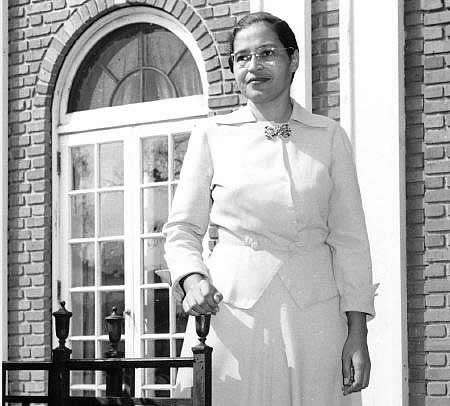 On Feb four, 1913, Rosa Louise McCauley was born in Tuskegee, Alabama to parents James McCauley and Leona Edwards. Her father was employed as a carpenter and her mother as a teacher. In her younger years she was sick much of the time, and as a result, was a small child. Her parents eventually separated and her mother took her and her brother and moved to Pine Level, a boondocks adjacent to Montgomery, Alabama. There Rosa spent the residue of her childhood on her grandparents' farm.
Her babyhood in Montgomery helped her to develop strong roots in the African Methodist Episcopal Church. Rosa did not nourish a public school until the historic period of eleven. Before that, she was home schooled by her mother. At age xi she attended the Industrial School for Girls in Montgomery, where she took various vocational and academic courses. She began laboratory school for her secondary education, but never completed information technology considering she was forced to drop out to care for her ailing grandmother.
Rosa's childhood was greatly influenced past the Jim Crow laws of the South, which segregated white people from black people in almost every part of their daily lives. This included public restrooms, drinking fountains, education and transportation. For the children attention school, there was busing for the white children to their school, only the blackness children were required to walk to another school. Public transportation followed this line of segregation except that blacks were allowed on the bus as long as they saturday in the dorsum, apart from the whites.
# Jim Crow Laws
The Jim Crow Laws that segregated blacks from whites were created past white members of the Democratic Political party in the Southern states between 1876 and 1963. They created many barriers for blackness voters and had several regulations including banning interracial spousal relationship and providing racially segregated school systems. This continued existence of this policy created and continued great political tension between the Northern and Southern states, both Autonomous and Republican Parties, on the bug of black rights.
This struggle brought to light a landmark slice of legislation, the Civil Rights Deed of 1964. President John F. Kennedy met with the Republican leaders on June eleven, 1963 prior to his television address that night to discuss the legislation. On June xiii, Everett McKinley Dirksen, Senate Minority Leader, and Mike Mansfield, Senate Bulk Leader, both voiced support for the president's neb except for provisions guaranteeing equal access to places of public accommodations. This bill was reported out of the Judiciary Committee in November 1963, and referred to the Rules Committee, chaired by Howard W. Smith, an avid segregationist and Democrat from Virginia, indicated his intention to keep the bill bottled up indefinitely.
In late November 1963 the shocking assassination of John F. Kennedy inverse the entire political situation. The new president, Lyndon Johnson, used his experience in legislative politics and the "cracking pulpit" he wielded as president in support of the beak. President Johnson signed the bill into law on July ii, 1964.
Civil Rights Human action voting results By political party and region:
Note: "Southern" refers to members of Congress from the xi states that made upward the "Confederate States of America" in the American Ceremonious War. "Northern" refers to members from the other 39 states, regardless of geographic location.
The original House version:
Southern Democrats: vii–87 (seven–93%) Southern Republicans: 0–ten (0–100%) Northern Democrats: 145–ix (94–6%) Northern Republicans: 138–24 (85–15%) The Senate version:
Southern Democrats: 1–20 (5–95%) Southern Republicans: 0–1 (0–100%) Northern Democrats: 45–1 (98–ii%) Northern Republicans: 27–5 (84–sixteen%)
Civil Rights Act voting results By party:
The original House version:
Autonomous Party: 152–96 (61–39%) Republican Party: 138–34 (eighty–20%) Cloture in the Senate:
Democratic Political party: 44–23 (66–34%) Republican Political party: 27–half dozen (82–18%) The Senate version:
Democratic Party: 46–21 (69–31%) Republican Party: 27–6 (82–18%) The Senate version, voted on by the Business firm:
Democratic Party: 153–91 (63–37%) Republican Party: 136–35 (80–xx%)
The passage of this important legislation and then led to the famous Voting Rights Act of 1965, signed into law by Lyndon B. Johnson on Baronial half-dozen, 1965.
Voting Rights Deed voting results By party:
The two numbers in each line of this list refer to the number of representatives voting in favor and against the deed, respectively.
Senate: 77–19
Democrats: 47–17 (73%-27%) Republicans: thirty–ii (94%-half dozen%) Firm: 333–85
Democrats: 221–61 (78%-22%) Republicans: 112–24 (82%-xviii%) Voting Rights Act Briefing Report:
Senate: 79–18
Democrats: 49–17 (4 Southern Democrats voted in favor: Albert Gore, Sr., Ross Bass, George Smathers and Ralph Yarborough). Republicans: 30–1 (the solitary nay was Strom Thurmond; John Tower who did not vote was paired equally a nay vote with Eugene McCarthy who would have voted in favor.) Business firm: 328–74
Democrats: 217–54 Republicans: 111–20
# The Ku Klux Klan
In her autobiography, Rosa recalls her grandad standing at the front end door of the farmhouse with a loaded shotgun in his paw while he watched as the Ku Klux Klan marched down their street. Every bit frightening as this was to her as a little girl, it taught her much about the very real prejudices confronting blacks in American civilization.
On the other hand, she besides tells of the many white people who were kind to her and her family every bit she grew up. Although aware of the prejudices of most of the white people in the S, she refused to permit information technology to taint her mental attitude towards the goodness of mankind. She attributes much of this to her strong faith in God and reliance on her church building in times of tribulation.
In 1932 Rosa Louis McCauley became Mrs. Raymond Parks in a small ceremony performed at her mother's home in Montgomery, Alabama. Her husband, a Montgomery barber, encouraged Rosa to finish her high school classes and get her loftier school diploma, which she successfully accomplished in 1933. She also managed to register to vote, later on only three tries.
Rosa joined her husband in their fight to raise money for the defense of the "Scottsboro Boys", a group of black men who had been falsely accused of raping two white women. Later on many years of influence past her husband, who was already a member, Rosa joined the NAACP in 1943 and was made the secretary to its president, Edgar Nixon. Rosa'southward volunteer position for the NAACP lasted for 13 years. In 1944, Rosa took a task working on the Maxwell Air Force Base. The air strength base was considered a federally owned surface area and segregation was non allowed. This was Rosa's showtime taste of a life of equality and was a turning bespeak in her attitude towards ceremonious rights. In Rosa's own words: "You might just say Maxwell opened my eyes up."
dominguezprioughter.blogspot.com
Source: https://rosaparksfacts.com/rosa-parks-early-life-childhood/
0 Response to "Rosa Parks as a Baby Rosa Parks Childhood Picture"
Postar um comentário